 ×
Brazilian panties, thongs and full briefs serve different coverage preferences. A private label collection should distinguish them through the actual back panel, rise and leg opening, then confirm those differences on fitted samples. A style name is a useful starting point, but it cannot specify the fit by itself.
For a small collection, choose one clearly defined role for each silhouette. Buyers should be able to explain why a customer would select one style over another before adding more colors or decorative variations.
Coverage describes how much of the seat the back panel covers. Rise describes where the waistband sits. A high waistband does not necessarily mean full rear coverage, and a low waistband does not automatically make a garment a thong.
Write both attributes into the development brief. Include front and back sketches, the intended waistband position and a reference for the rear leg curve. If the buyer and factory interpret “Brazilian” differently, these references provide something concrete to compare.
Silhouette |
Main distinction to approve |
Collection role to consider |
Brazilian |
Partial rear coverage with a defined leg curve |
An option between fuller coverage and a thong |
Thong |
A narrow rear section with a specified gusset transition |
A minimal coverage option |
Full brief |
Broader seat coverage and the intended rise |
A fuller coverage everyday option |
These roles are planning choices. They do not predict sales, comfort or invisibility under every outfit.
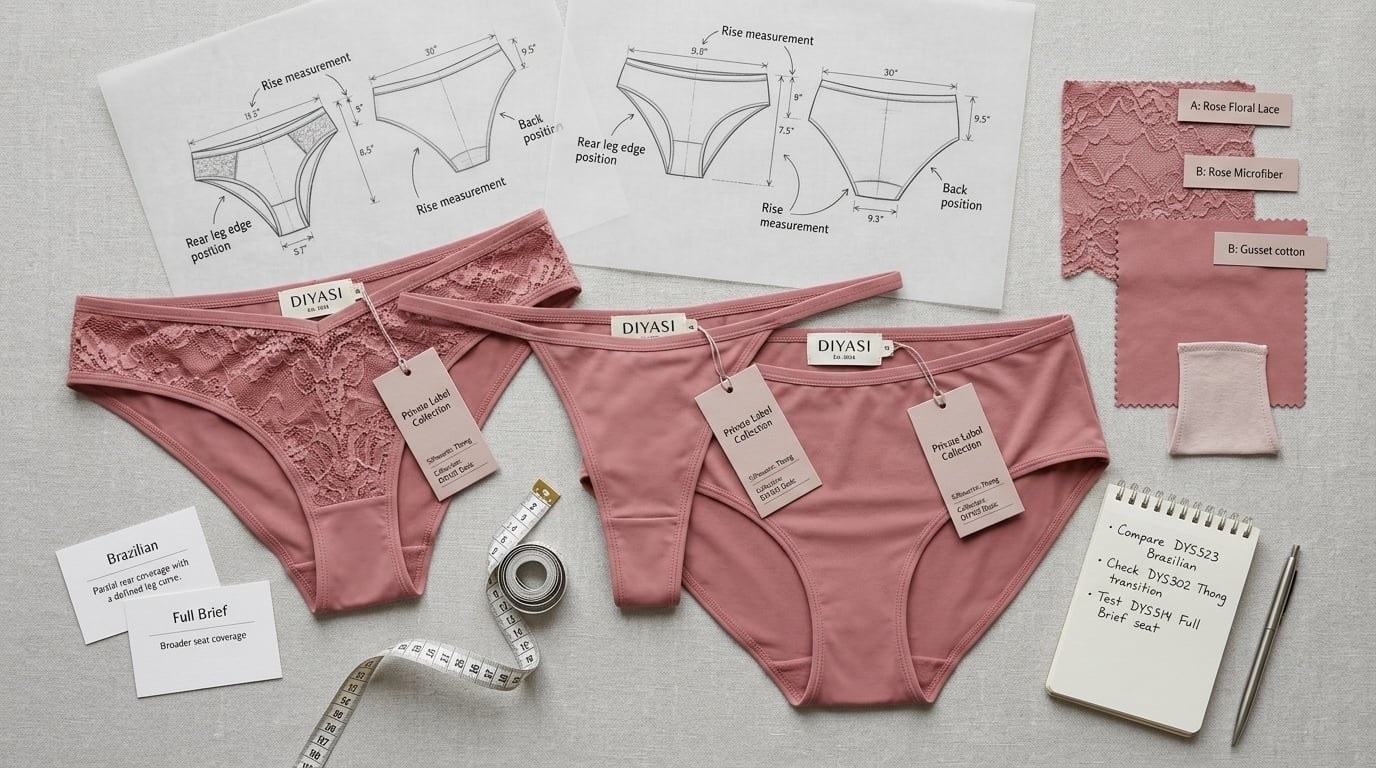
DIYASI lists DYS323 Brazilian panties, the DYS302 thong and DYS314 full coverage panties. These product references make it possible to discuss different silhouettes without relying only on generic category names.
Request the same intended wearer size when comparing samples. Record differences in fabric, waistband treatment and gusset attachment before attributing a fit result to coverage. A softer edge or a different rise can change the wearing impression even when two garments have similar back panels.
Lay the garments flat for the initial comparison, then review how they sit when worn. Flat photographs alone do not show whether a leg edge moves inward, the back waistband drops during sitting, or excess fabric gathers beneath clothing.
For the Brazilian style, check whether the rear edge stays close to its intended position during walking and sitting. For the thong, review the transition from the front panel through the gusset to the narrow back. For the full brief, check whether the seat remains covered without excess fabric collecting at the lower edge.
Use consistent outer clothing and lighting when comparing appearance. Record which sample, size and outfit produced each observation. A result under one pair of trousers should not become an unrestricted “invisible under clothing” claim.
Ask wearers to describe the location and timing of any discomfort. “The rear leg edge moves after sitting” is more useful development feedback than “the fit feels wrong.”
If two samples serve almost the same customer preference, select the stronger option before multiplying colors. A range can begin with one fuller coverage style and one lighter coverage style, then add another silhouette when customer feedback identifies a distinct need.
Use separate product photographs and clear coverage descriptions on retail pages. Avoid presenting all three as interchangeable simply because they share a color palette. The collection should make the choice easier for shoppers and make reorder decisions easier for the brand.
To discuss a coverage assortment, send DIYASI your selected product references, target size range, preferred rise, colors and estimated quantity by style. Request current specifications and samples for each chosen silhouette before confirming the order.



 EN